


剩余参数、instanceof运算符、区间for循环、switch语句块、数组、this、static语句块、final关键字等的基本使用。
package _00_EasySeries;
import java.util.ArrayList;

// 1. 剩余参数..args
class Arg {
    public static double variableParamsMaxValue(double ...args) {
        if(args.length == 0) {
            return 0.0;
        } else {
            double max = args[0];
            for(int i = 1; i < args.length; i++) {
                if(max < args[i]) {
                    max = args[i];
                }
            }
            return max;
        }
    }
    public static double maxValue(double value, double ...args) {
        if(args.length == 0) {
            return value;
        } else {
            double
             max = value;
            for(int i = 0; i < args.length; i++) {
                if(max < args[i]) {
                    max = args[i];
                }
            }
            return max;
        }
    }
    public static void show(int...args) {
        for(int value: args) {
            System.out.print(value + " ");
        }
        System.out.println("");
    }
}

// 2. instanceof 运算符
// 该运算符用于操作对象实例,检查该对象是否是一个特定类型(类类型或接口类型)。
class Father {}
class Son extends Father {}
class Other {
    static void test() {
        String name = "Hi";
        System.out.println(name instanceof String);     // true

        Father father = new Son();
        System.out.println(father instanceof Son);      // true
    }
}

// 3. 区间for循环
class For {
    static void test() {
        ArrayList<String> list = new ArrayList<String>();
        list.add("Hello");
        list.add("World");
        list.add("hello");
        list.add("world");
        for (String str : list)
            System.out.print(str + " ");
        System.out.println("");
    }
}

// 4. Switch
// default作为没有匹配成功的默认操作, 但是并没有强制一定要写在最后面。
// Switch语句的表达式在Java5之前只能是byte, short, int或者char类型,
// Java5中增加了enum,Byte,Short,Integer,Character,Java7中增加了String的支持。
class Switch {
    static void test() {
        int value = 3;
        switch(value) {
            case 1:
                System.out.println("1");
                break;
            default:
                System.out.println("default");
                break;
            case 2:
                System.out.println("2");
                break;
        }
    }
}

// 5.数组
class _Array {
    static void array1() {
        int[] arr1 = new int[3];
        arr1[0] = arr1[1] = arr1[2] = 100;

        int[] arr2 = { 111, 222 };
        int[] arr3 = new int[] { 111, 222 };        // 不要指定维数

        for(int num: arr3) {
            System.out.println("arr3:>" + num);
        }
    }

    static void array2() {
        int[][] arr1 = {{1,2}, {3,4}, {5,6}};       // 3行2列
        int[][] arr2 = new int[][] {{1,2},{3,4},{5,6}};     // 不要指定维数
        int[][] arr3 = new int[][] {{1}, {2,3}, {4,5,6}};   // 不规则数组
        for(int[] row: arr3) {
            for(int col: row) {
                System.out.print(col + " ");
            }
        }
        System.out.println("");
    }
}

// 6. this
// 构造函数This()中的 this(2,3)相当于调用This的构造函数This(int,int)完成对x,y的初始化;
// 必须是通过this来调用, 而不能直接通过构造函数名来调用;
// 此类写法可能并不具实际意义,此处只是演示一下。
class This {
    private int x;
    private int y;

    This() {
        this(2, 3);
    }

    This(int x, int y) {
        this.x = x;
        this.y = y;
    }

    void show() {
        System.out.println("x:> " + x + "  " + "y:> " + y);
    }
}

// 7. static语句块
// 构造函数是在new对象时被调用进而用来对对象进行一些初始化操作;
// 而static语句块则是在类加载时被调用, 用于初始化一些全局地方设置;
// 说白了, static语句块就是在new对象之前先被调用;
class Static {
    static {
        System.out.println("initialize int static statement block.");
    }
    Static() {
        System.out.println("in Static constructor.");
    }
}

// 8. final常量
// C/C++中用const来定义常变量的; 那么在Java中是用final来定义常变量的;
// final常量必须进行初始化操作, 否则报错;
// 可以在定义时直接给其赋初值,也可以直接在构造函数中初始化;
// 切记, 重载构造函数时, 在重载的构造函数中也必须对其进行初始化, 否则报错;
class Final {
    final double PI;
    Final() {
        PI = 32.4;
    }
    Final(int num) {
        PI = 32.4;      // must init it, or error.
    }
    Final(int num, double value) {
        PI = 32.4;      // must init it, or error.
    }
}

class App {
    public static void main(String[] args) {
        //
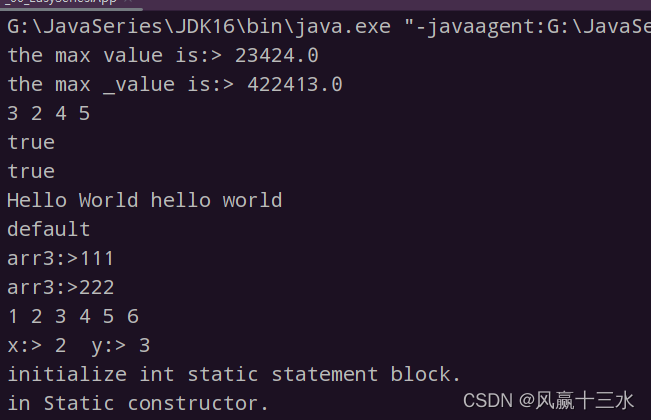
        double value = Arg.variableParamsMaxValue(1121,424,534,234,664,23424);
        double _value = Arg.maxValue(12342, 23,23,242,12314,422413,4131,412);
        System.out.println("the max value is:> " + value);
        System.out.println("the max _value is:> " + _value);
        Arg.show(new int[]{3,2,4,5});
        //
        Other.test();
        //
        For.test();
        //
        Switch.test();
        //
        _Array.array1();
        _Array.array2();
        //
        This _this = new This();
        _this.show();
        //
        Static _static = new Static();
    }
}






 扫一扫
扫一扫


 2007
2007

 被折叠的 条评论
为什么被折叠?
被折叠的 条评论
为什么被折叠?
 到【灌水乐园】发言





