


一、文件IO相关函数
1.read/write cp
#include <fcntl.h>
#include <sys/stat.h>
#include <sys/types.h>
#include <stdio.h>
#include<unistd.h>
#include<string.h>

int main(int argc, char **argv)
{
  if(argc<3)
  {
    fprintf(stderr, "usage:./a.out srcfile dstfile\n");
    return 1;
  }
  int srcfd = open(argv[1],O_RDONLY);
  int dstfd = open(argv[2], O_WRONLY | O_CREAT | O_TRUNC, 0666);
  if (-1 == srcfd||dstfd==-1)
    {
      fprintf(stderr, "open error\n");
      return 1;
    }
  while(1)
  {

    char buf[1024]={0};
    ssize_t ret= read(srcfd, buf, sizeof(buf));
    if(0==ret)
    {
      break;
    }
    write(dstfd, buf, ret);
  }
  close(srcfd);
  close(dstfd);

  return 0;
}
2.文件的插入功能(insert_hw.c)
#include<stdio.h>
#include<string.h>
#include<stdlib.h>

int	main(int argc, char **argv)
{
    FILE*fp=fopen("1.txt","r+");
    if(NULL==fp)
    {
        fprintf(stderr, "fopen error\n");
        return 1;
    }

    char data[]="aaa";
    int pos=4;
    fseek(fp,0,SEEK_END);
    long size=ftell(fp);
    fseek(fp, pos, SEEK_SET);
    char*end = malloc(size-pos);
    if(NULL==end)
    {
        return 1;
    }
    fread(end, size-pos, 1, fp);
    fseek(fp, pos, SEEK_SET);

    fputs(data,fp);
    fputs(end, fp);
    free(end);
    fclose(fp);

    return 0;
}
3.查字典
(1)klist.c
#include "./klist.h"

void klist_init(KLIST* head)
{
    head->prev = head;
    head->next = head;
}

void klist_add(KLIST* newnode,KLIST*prev,KLIST* next)
{
    newnode->next =next;
    newnode->prev = prev;
    prev->next = newnode;
    next->prev = newnode;


}

void klist_add_head(KLIST* head,KLIST* newnode)
{
    klist_add(newnode,head,head->next);
}
void klist_add_tail(KLIST* head,KLIST* newnode)
{

    klist_add(newnode,head->prev,head);
}

void klist_del(KLIST*prev,KLIST*next)
{
    prev->next = next;
    next->prev = prev;
}
(2)klist.h
#ifndef __KLIST_H__
#define __KLIST_H__


typedef struct __klist
{
    struct __klist *next;
    struct __klist* prev;
}KLIST;

#define offset(type,mem) ((size_t)  &((type*)0)->mem)
/**
 * @brief ptr 结构体node的指针
            type 结构体 per
 *       mem  node在结构中的变量名
 */
#define containerof(ptr,type,mem) ({ const typeof(((type*)0)->mem) * _mptr = (ptr);\
   (type*) ((char*)_mptr- offset(type,mem)); })

#define klist_for_entry(ptr,type,mem)  containerof(ptr,type,mem)
/**
 * @brief p , 指向结构体的指针
 *        n, 指向当前结构体的下一个指针
         mem, node在结构体中变量的名字
 */
//for(p=klist_for_entry(&(head)->next,typeof(*p),mem),n=klist_for_entry((p)->mem.next,typeof(*p),mem);
#define klist_for_each(p,n,head,mem) \
for(p=klist_for_entry(head->next,typeof(*p),mem),n=klist_for_entry((p)->mem.next,typeof(*p),mem);\
&p->mem != (head); p=n,n=klist_for_entry((n)->mem.next,typeof(*n),mem))

// #define offset(type,mem) ((size_t) &((type*)0)->mem)
// #define containerof(p,type,mem) ({\
// const typeof(  ((type*)0)->mem ) * _mptr = (p);\
// (type*)((char*)_mptr - offset(type,mem));})
// #define klist_entry(p,type,mem) containerof(p,type,mem)

// #define klist_for_each(p,n,head,node)\
// for(p=klist_entry((head)->next,typeof(*p),node),\
//     n=klist_entry(p->node.next,typeof(*p),node);        \
//     &p->node != (head);p=n,n=klist_entry(n->node.next,typeof(*n),node))

void klist_init(KLIST* head);
void klist_add_head(KLIST* head,KLIST* newnode);
void klist_add_tail(KLIST* head,KLIST* newnode);
void klist_del(KLIST*prev,KLIST*next);

#endif
(3)main.c
#include <stdio.h>
#include <stdlib.h>
#include <string.h>
#include "klist.h"
typedef struct
{
  char word[50];
  char mean[512];
  KLIST node;
} DATATYPE;

int add_word(char* word, char* mean, KLIST* head)
{
  DATATYPE* data = malloc(sizeof(DATATYPE));
  if (NULL == data)
    {
      perror("add_per malloc\n");
      return 1;
    }
  strcpy(data->word, word);
  strcpy(data->mean, mean);
  klist_add_tail(head, &data->node);
  return 0;
}

DATATYPE* find_word(KLIST* head, char* word)
{
  DATATYPE *p, *n;
  // p 代表当前节点  n 是当前节点的下一个  head 链表的头指针 node
  // ,自定义结构体中,节点变量的名字

  klist_for_each(p, n, head, node)
  {
    // printf("%d %s\n",p->id,p->name);
    if (0 == strcmp(p->word, word))
      {
        return p;
      }
  }

  return NULL;
}

int main(int argc, char** argv)
{
  FILE* fp = fopen("/home/linux/dict.txt", "r");
  if (NULL == fp)
    {
      return 1;
    }
  KLIST head;
  klist_init(&head);
  while (1)
    {
      char buf[1024] = {0};
      if (NULL == fgets(buf, sizeof(buf), fp))
        {
          break;
        }
      char* word = strtok(buf, " ");
      char* mean = strtok(NULL, "\r");
      add_word(word, mean, &head);
    }

  while (1)
    {
      char want_word[50] = {0};
      printf("input word:");
      fgets(want_word, sizeof(want_word), stdin);  // zoo\n #quit
      want_word[strlen(want_word) - 1] = '\0';
        if(0==strcmp(want_word,"#quit"))
        {
            break;
        }
      DATATYPE* tmp = find_word(&head, want_word);
      if (NULL == tmp)
        {
          printf("can't find, %s\n", want_word);
        }
      else
        {
          printf("%s %s\n", tmp->word, tmp->mean);
        }
    }
  // system("pause");
  return 0;
}
4.lseek
off_t lseek(int fd, off_t offset, int whence);
功能:定位光标的位置
参数:fd:文件描述符;offset:偏移量;正:向后偏移;负:向前偏移;零:不偏移
whence:SEEK_SET;SEEK_CUR;SEEK_END
返回值:成功返回偏移量;失败返回-1
#include <fcntl.h>
#include <sys/stat.h>
#include <sys/types.h>
#include <stdio.h>
#include<unistd.h>
#include<string.h>

int	main(int argc, char **argv)
{
    int fd = open("1.txt", O_WRONLY|O_CREAT|O_TRUNC,0666);
    if(-1==fd)
    {
        fprintf(stderr, "open error");
        return 1;
    }
    off_t offset = lseek(fd, 1024, SEEK_SET);
    printf("%ld\n",offset);
    write(fd, "a", 2);
    close(fd);
    return 0;
}
5.fopen与open 对应权限问题
fopen open
w O_WRONLY|O_CREAT|O_TRUNC
w+ O_RDWR|O_CREAT|O_TRUNC
r O_RDONLY
r+ O_RDWR
a O_WRONLY|O_CREAT|O_APPEND
a+ O_RDWR|O_CREAT|O_APPEND
6.fileno
转换: FILE* fp -> int fd fgets(,);
int fileno(FILE *stream);
功能:获得一个文件流指针中的文件描述符
参数:stream:文件流指针
返回值:成功返回文件描述符;失败返回-1
#include<stdio.h>
#include <unistd.h>

int	main(int argc, char **argv)
{
    FILE*fp = fopen("2.txt", "w");
    if(NULL==fp)
    {
        return 1;
    }
    int fd = fileno(fp);
    write(fd, "hello", 5);
    fclose(fp);
    return 0;
}
7.fdopen
转换:int fd -> FILE *fp
FILE *fdopen(int fd, const char *mode);
功能:将文件描述符转化为文件流指针
参数:fd:已经打开的文件描述符
mode:"r" "r+" "w" "w+" "a" "a+"
返回值:成功返回文件流指针;失败返回NULL
#include<stdio.h>
#include <unistd.h>
#include<fcntl.h>

int	main(int argc, char **argv)
{
    int fd = open("2.txt", O_RDONLY);
    if(-1==fd)
    {
        return 1;
    }
    FILE*fp = fdopen(fd, "r");
    if(NULL==fp)
    {
        return 1;
    }
    char buf[512]={0};
    fgets(buf,sizeof(buf),fp);
    printf("%s",buf);
    fclose(fp);
    return 0;
}
8.perror 系统错误警告
#include <stdio.h>
#include <errno.h>

int	main(int argc, char **argv)
{
    FILE*fp = fopen("5.txt", "r");
    if(NULL==fp)
    {
        printf("error %d\n",errno);
        perror("fopen main.c:10");
    }
    return 0;
}
二、目录操作
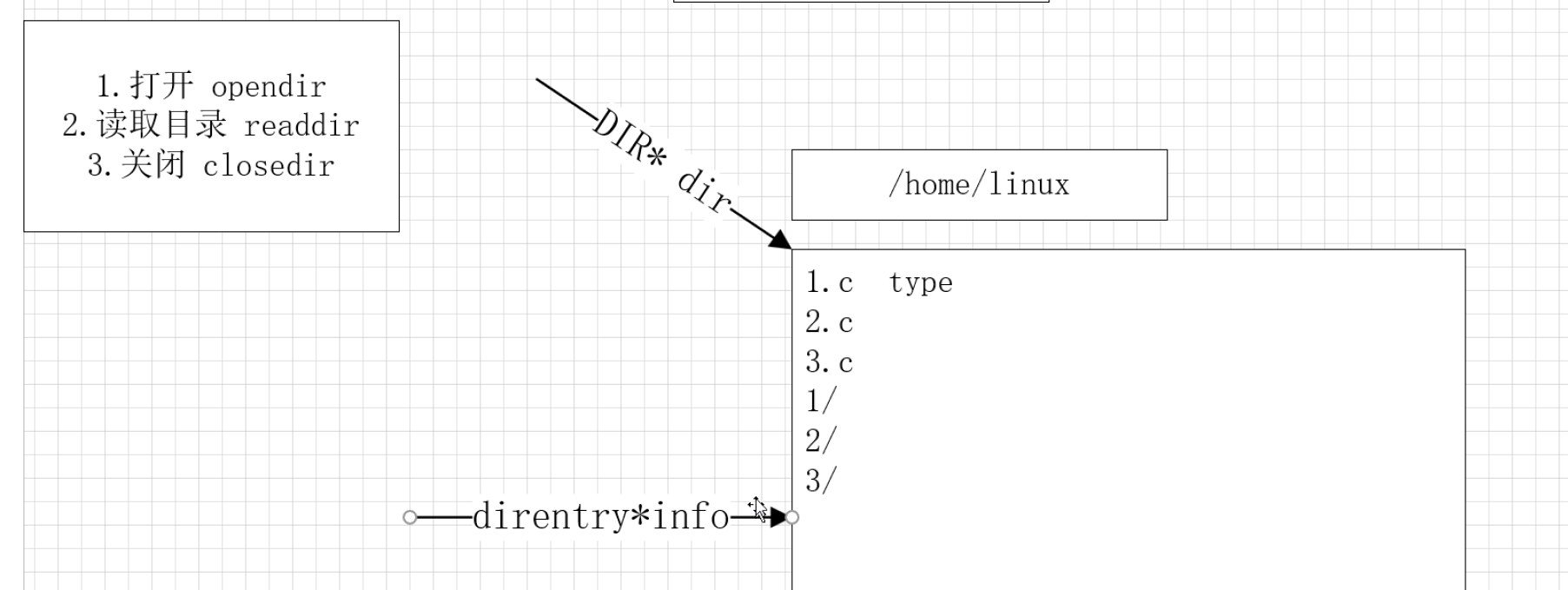
1.步骤
- 打开目标目录
- 读取目录
- 关闭目录
2. 目录的遍历-ls
#include <stdio.h>
#include <sys/types.h>
#include <dirent.h>
#include <unistd.h>

int	main(int argc, char **argv)
{
    DIR*dir=opendir("../");
    if(NULL==dir)
    {
        perror("opendir");
        return 1;
    }

    while (1)
    {
       struct dirent*info= readdir(dir);
       if(NULL==info)
       {
         break;
       }
       printf("%s\n",info->d_name);
    }
    closedir(dir);
    return 0;
}
3.time
#include <stdio.h>
#include <time.h>

int	main(int argc, char **argv)
{
    time_t tm;
    tm =time(NULL);

    printf("%ld\n",tm);
    struct tm*tminfo = localtime(&tm);
    printf("%d-%d-%d %d:%d:%d\n",tminfo->tm_year+1900,tminfo->tm_mon+1,tminfo->tm_mday
    ,tminfo->tm_hour,tminfo->tm_min,tminfo->tm_sec);
    return 0;
}





 扫一扫
扫一扫


 343
343

 被折叠的 条评论
为什么被折叠?
被折叠的 条评论
为什么被折叠?
 到【灌水乐园】发言





