


前面两节介绍了一下 linux 中进程的资源,本节再来学习下 linux 中 cfs 进程的调度。
linux 进程的时间记账

上一节说到为了尽量让每个进程都有相对公平的机会运行,linux 在设计进程调度时,提出了 cpu使用比的概念,那么 linux 是如何统计每个进程的 cpu 使用比的呢?这就需要对每个进程进行时间记账了。
事实上,不仅是 linux,几乎所有调度器都需要对进程的运行时间记账。多数类 unix 系统都会分配给进程一个时间片,每当系统的时钟节拍增加时,进程的时间片就相应的减少一个节拍周期,进程的时间片减小到 0 就会被别的进程抢占。
虽然上一节说到 linux 的 cfs 调度法不再使用时间片(使用cpu使用比),但是它也仍然需要记录每一个进程的运行时间,因为 cfs 需要知道每个进程的运行状态,才能做出相对公平的调度。cfs 用于记录时间的结构体如下:
struct sched_entity { struct load_weight load; /* for load-balancing */ struct rb_node run_node; struct list_head group_node; unsigned int on_rq; u64 exec_start; u64 sum_exec_runtime; u64 vruntime; u64 prev_sum_exec_runtime; u64 last_wakeup; u64 avg_overlap;...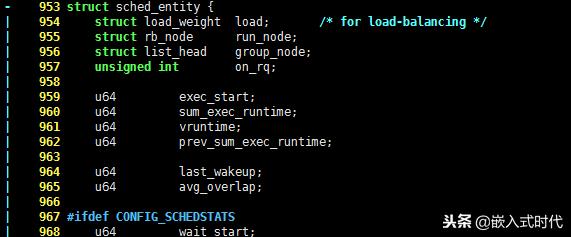
这是一个比较大的结构体,在之前的文章中提到 linux 中的进程资源都是记录在 struct task_struct 结构体内的,task_struct 结构体有个成员 se 就是 struct sched_entity 类型的:
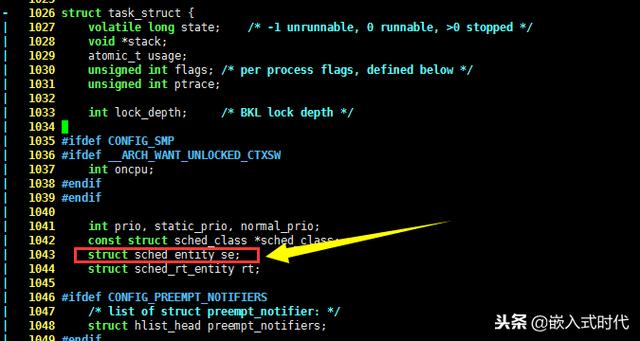
知道了每个进程的运行时间,要计算它的 cpu 使用比,还需要所有进程的运行时间总和,linux 内核是使用 vruntime 记录这一数值的,它的单位是 ns。为了让总 vruntime 不与定时器相关,总 vruntime 实际上是所有进程运行时间经过加权处理的。
linux 的记账函数
现在知道了 linux 的时间账本记录在哪里了,那么谁负责记账呢?其实就是 update_curr() 函数了,它的代码如下,请看:
430 static void update_curr(struct cfs_rq *cfs_rq)- 431 { | 432 struct sched_entity *curr = cfs_rq->curr;| 433 u64 now = rq_of(cfs_rq)->clock;| 434 unsigned long delta_exec;| 435 | 436 if (unlikely(!curr))| 437 return;| 438 |- 439 /*|| 440 * Get the amount of time the current task was running|| 441 * since the last time we changed load (this cannot|| 442 * overflow on 32 bits):|| 443 */ | 444 delta_exec = (unsigned long)(now - curr->exec_start);| 445 | 446 __update_curr(cfs_rq, curr, delta_exec);| 447 curr->exec_start = now;| 448 |- 449 if (entity_is_task(curr)) {|| 450 struct task_struct *curtask = task_of(curr);|| 451 || 452 cpuacct_charge(curtask, delta_exec);|| 453 }| 454 }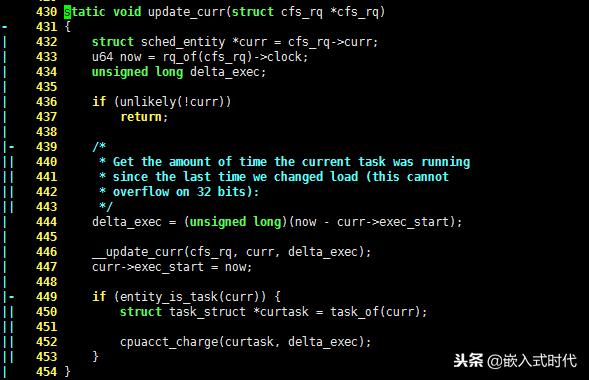
可以看出,delta_exec 记录着进程的运行时间。它的计算方法也很简单:curr->exec_start 记录了进程的创建时间,delta_exec 就是当前时间减去创建时间的时间差。__update_curr() 函数则是负责统计 vruntime 的:
412 static inline void 413 __update_curr(struct cfs_rq *cfs_rq, struct sched_entity *curr, 414 unsigned long delta_exec)- 415 { | 416 unsigned long delta_exec_weighted;| 417 | 418 schedstat_set(curr->exec_max, max((u64)delta_exec, curr->exec_max));| 419 | 420 curr->sum_exec_runtime += delta_exec;| 421 schedstat_add(cfs_rq, exec_clock, delta_exec);| 422 delta_exec_weighted = delta_exec;|- 423 if (unlikely(curr->load.weight != NICE_0_LOAD)) {|| 424 delta_exec_weighted = calc_delta_fair(delta_exec_weighted,|| 425 &curr->load);|| 426 }| 427 curr->vruntime += delta_exec_weighted;| 428 }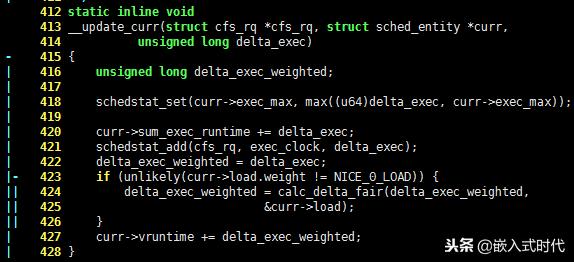
进程调度,让每个进程都有相对公平的机会运行
现在 cfs 已经知道每个进程的执行状况了,那么挑选哪个进程投入运行呢?答案是显而易见的,cfs 为了给每个进程相对公平的机会运行,总是挑选具有最小 vruntime 的进程。
为了快速找到拥有 vruntime 的进程,linux 内核借用了红黑树的数据结构。最小的 vruntime 总是在树的最左侧叶子节点,请看如下代码:
295 static inline struct rb_node *first_fair(struct cfs_rq *cfs_rq)- 296 { | 297 return cfs_rq->rb_leftmost;| 298 } 299 300 static struct sched_entity *__pick_next_entity(struct cfs_rq *cfs_rq)- 301 { | 302 return rb_entry(first_fair(cfs_rq), struct sched_entity, run_node);| 303 } 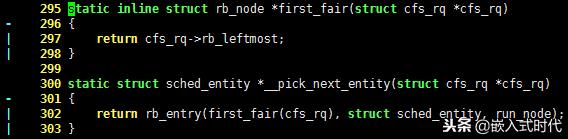
看到这里,知道 linux 内核在往树中加入进程时,就应该将树处理好,这一过程由 enqueue_entity 函数完成:
622 static void 623 enqueue_entity(struct cfs_rq *cfs_rq, struct sched_entity *se, int wakeup)- 624 {|- 625 /*|| 626 * Update run-time statistics of the 'current'.|| 627 */| 628 update_curr(cfs_rq);| 629 account_entity_enqueue(cfs_rq, se);| 630 |- 631 if (wakeup) {|| 632 place_entity(cfs_rq, se, 0);|| 633 enqueue_sleeper(cfs_rq, se);|| 634 }| 635 | 636 update_stats_enqueue(cfs_rq, se);| 637 check_spread(cfs_rq, se);| 638 if (se != cfs_rq->curr)| 639 __enqueue_entity(cfs_rq, se);| 640 }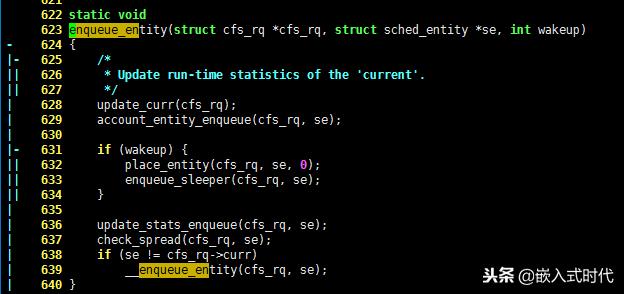
可以看出,enqueue_entity 函数更新了进程的运行时间,最终将数据插入树的实际上是__enqueue_entity() 函数:
227 static void __enqueue_entity(struct cfs_rq *cfs_rq, struct sched_entity *se)- 228 {| 229 struct rb_node **link = &cfs_rq->tasks_timeline.rb_node;| 230 struct rb_node *parent = NULL;| 231 struct sched_entity *entry;| 232 s64 key = entity_key(cfs_rq, se);| 233 int leftmost = 1;| 234 |- 235 /* || 236 * Find the right place in the rbtree:|| 237 */ |- 238 while (*link) {|| 239 parent = *link;|| 240 entry = rb_entry(parent, struct sched_entity, run_node);||- 241 /*||| 242 * We dont care about collisions. Nodes with||| 243 * the same key stay together.||| 244 */||- 245 if (key < entity_key(cfs_rq, entry)) {||| 246 link = &parent->rb_left; ||| 247 } else {||| 248 link = &parent->rb_right;||| 249 leftmost = 0;||| 250 }|| 251 }| 252 |- 253 /*|| 254 * Maintain a cache of leftmost tree entries (it is frequently|| 255 * used):|| 256 */|- 257 if (leftmost) {|| 258 cfs_rq->rb_leftmost = &se->run_node;||- 259 /*||| 260 * maintain cfs_rq->min_vruntime to be a monotonic increasing||| 261 * value tracking the leftmost vruntime in the tree.||| 262 */|| 263 cfs_rq->min_vruntime =|| 264 max_vruntime(cfs_rq->min_vruntime, se->vruntime);|| 265 }| 266 | 267 rb_link_node(&se->run_node, parent, link);| 268 rb_insert_color(&se->run_node, &cfs_rq->tasks_timeline);| 269 }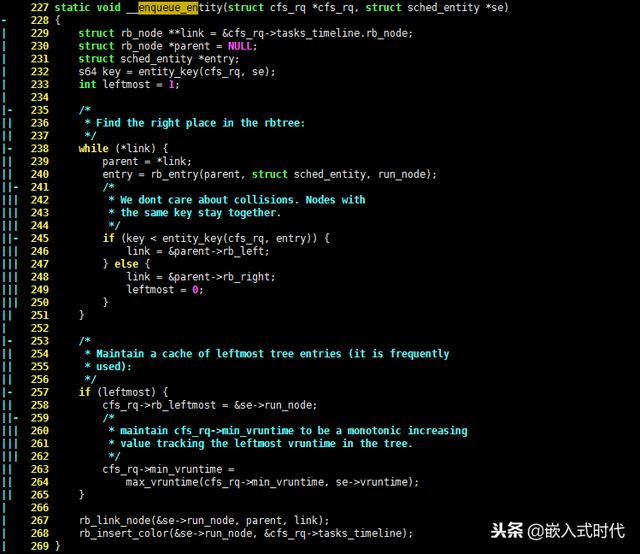
可以看出,linux 内核一直将树的最左节点维护在缓存 cfs_rq->rb_leftmost 里,这样一来,cfs 在选择哪一个进程应该被投入运行时,能够非常快速的做出决定。
至此,linux 内核中经典的 cfs 进程调度设计,就比较熟悉了。
欢迎在评论区一起讨论,质疑。文章都是手打原创(本文参考linux内核原理和设计),每天最浅显的介绍C语言、linux等嵌入式开发,喜欢我的文章就关注一波吧,可以看到最新更新和之前的文章哦。





 扫一扫
扫一扫


 被折叠的 条评论
为什么被折叠?
被折叠的 条评论
为什么被折叠?
 到【灌水乐园】发言





