



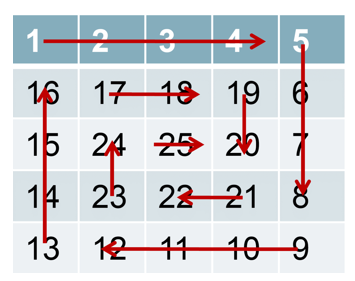
实现的方法由很多种,此处仅按层模拟法。
核心思想
将矩阵想象成一个洋葱,从最外层开始,一层一层地向内填充数字,每一层都按照 "上→右→下→左" 的顺序填充。
关键变量说明
c
int left = 0, right = n - 1;    // 当前层的左右边界
int top = 0, bottom = n - 1;    // 当前层的上下边界
int num = 1;                    // 当前要填充的数字
填充过程的详细分解
步骤1:填充上层(从左到右)
text
初始状态:left=0, right=3, top=0, bottom=3

   left     right
    ↓         ↓
top → [ 1   2   3   4 ]
      [              ]
      [              ]
      [              ]
代码执行:
c
for (int i = left; i <= right; i++) {
    matrix[top][i] = num++;
}
top++;  // 上边界下移
步骤2:填充右层(从上到下)
text
当前状态:left=0, right=3, top=1, bottom=3

      [ 1   2   3   4 ]
top → [           ↑   5 ]
      [           ↑   6 ]
      [           ↑   7 ]
               right
代码执行:
c
for (int i = top; i <= bottom; i++) {
    matrix[i][right] = num++;
}
right--;  // 右边界左移
步骤3:填充下层(从右到左)
text
当前状态:left=0, right=2, top=1, bottom=3

      [ 1   2   3   4 ]
      [           ↑   5 ]
      [           ↑   6 ]
bottom→ [ 10   9   8   7 ]
         ←────────┘
代码执行:
c
for (int i = right; i >= left; i--) {
    matrix[bottom][i] = num++;
}
bottom--;  // 下边界上移
步骤4:填充左层(从下到上)
text
当前状态:left=0, right=2, top=1, bottom=2

      [ 1   2   3   4 ]
top → [ 11   ↑       5 ]
      [ 10   ↑       6 ]
      [  9   8       7 ]
      ↑
    left
代码执行:
c
for (int i = bottom; i >= top; i--) {
    matrix[i][left] = num++;
}
left++;  // 左边界右移
完整循环过程演示(4×4矩阵)
第一层循环:
text
初始: [ .   .   .   . ]
      [ .   .   .   . ]
      [ .   .   .   . ]
      [ .   .   .   . ]

步骤1: [ 1   2   3   4 ]  ← 上边
      [ .   .   .   . ]
      [ .   .   .   . ]
      [ .   .   .   . ]

步骤2: [ 1   2   3   4 ]  ← 上边
      [ .   .   .   5 ]   ← 右边
      [ .   .   .   6 ]   ↑
      [ .   .   .   7 ]   ↑

步骤3: [ 1   2   3   4 ]  ← 上边
      [ .   .   .   5 ]   ← 右边
      [ .   .   .   6 ]   ↑
      [ 10  9   8   7 ]   ← 下边

步骤4: [ 1   2   3   4 ]  ← 上边
      [ 11  .   .   5 ]   ← 右边
      [ 10  .   .   6 ]   ↑
      [ 9   8   7   . ]   ← 下边
第二层循环:
text
当前: [ 1   2   3   4 ]
      [ 11  .   .   5 ]
      [ 10  .   .   6 ]
      [ 9   8   7   . ]

步骤1: [ 1   2   3   4 ]
      [ 11  12  13  5 ]  ← 上边(内层)
      [ 10  .   .   6 ]
      [ 9   8   7   . ]

步骤2: [ 1   2   3   4 ]
      [ 11  12  13  5 ]
      [ 10  .   .   6 ]
      [ 9   8   7   . ]
              ↑ 右边(内层) - 无空间

步骤3: [ 1   2   3   4 ]
      [ 11  12  13  5 ]
      [ 10  15  14  6 ]  ← 下边(内层)
      [ 9   8   7   . ]

步骤4: [ 1   2   3   4 ]
      [ 11  12  13  5 ]
      [ 10  15  14  6 ]
      [ 9   8   7  16 ]  ← 左边(内层) - 无空间
边界条件的重要性
c
if (top <= bottom) {
    // 填充下边 - 确保还有行需要填充
}

if (left <= right) {
    // 填充左边 - 确保还有列需要填充
}
这些条件防止在奇数×奇数矩阵的最后阶段重复填充。
算法特点
-
时间复杂度:O(n²) - 每个元素只访问一次
-
空间复杂度:O(1) - 只用了几个辅助变量(不包括结果矩阵)
-
稳定性:逻辑清晰,不容易出错
-
适用性:适合各种大小的方阵
这种方法的优势在于它的直观性和可预测性,通过维护四个边界指针,清晰地定义了每一层的填充范围。
#include <stdio.h>

void spiralMatrix(int n) {
    int matrix[n][n];
    int num = 1;
    int left = 0, right = n - 1;
    int top = 0, bottom = n - 1;

    while (left <= right && top <= bottom) {
        // 从左到右填充上边
        for (int i = left; i <= right; i++) {
            matrix[top][i] = num++;
        }
        top++;

        // 从上到下填充右边
        for (int i = top; i <= bottom; i++) {
            matrix[i][right] = num++;
        }
        right--;

        // 从右到左填充下边
        if (top <= bottom) {
            for (int i = right; i >= left; i--) {
                matrix[bottom][i] = num++;
            }
            bottom--;
        }

        // 从下到上填充左边
        if (left <= right) {
            for (int i = bottom; i >= top; i--) {
                matrix[i][left] = num++;
            }
            left++;
        }
    }

    // 打印螺旋矩阵
    printf("luoxuan juzheng %dx%d:\n", n, n);
    for (int i = 0; i < n; i++) {
        for (int j = 0; j < n; j++) {
            printf("%3d ", matrix[i][j]);
        }
        printf("\n");
    }
}

int main() {
    int n;
    printf("input how big: ");
    scanf("%d", &n);

    spiralMatrix(n);
    return 0;
}





 扫一扫
扫一扫


 727
727

 被折叠的 条评论
为什么被折叠?
被折叠的 条评论
为什么被折叠?
 到【灌水乐园】发言





