Supervised Descent Method Face Alignment 代码下载 和 算法研究 之一

介绍Supervised Descent Method (SDM)算法及其在人脸对齐中的应用。SDM针对传统牛顿法在计算机视觉场景下的局限性,提出了一种新的优化方法。在训练阶段,通过最小化所有样本的非线性平方差函数之和,学习得到一系列梯度方向;在测试阶段,利用这些梯度方向进行非线性平方差函数的极小化,无需计算雅可比矩阵或海森矩阵。

1 主要内容:
Supervised Descent Method and its Applications to Face Alignment算法研究。

2代码彩蛋:我问了好久,xxiong好心人发给我的,希望能对你们学习有帮助:
低调下载:
http://humansensing.cs.cmu.edu/xxiong/mexintraface1.3.1%28release%29.zip
注意杜绝一切商业用途,如果需要商业用途,请联系作者本人!!

3本文分为几个部分:
(1)解决什么问题
(2)具体理论方法是什么
(3)具体实现步骤

(1)解决什么问题
上一篇文章newton方法,请看具体实现,

这里写图片描述
牛顿法目的是求f(x)最小值。然后改成求f’(x)=0。
迭代n次上图公式1,直到Xk+1 - Xk收敛到0.0001
or 其他非常小大于0的值。
而公式1中 f’(x)是上图中J(f(Xk))函数, 而f”(x)是H(Xk).
下图为该方法:
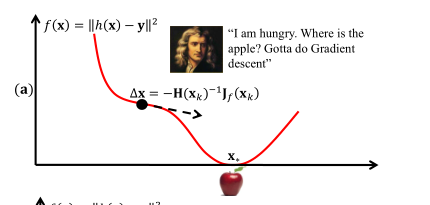
这里写图片描述

这里写图片描述是牛顿迭代的梯度方向。
更多内容请看:上一篇牛顿法-最优方法。
我们知道牛顿法:要满足在定义域内二次可微,hession矩阵正定。

而在计算机背景下,运用newton method有三个问题:
1 Hession矩阵在最小值的局部是正定的,但在其他地方可能不正定。
因为只有Hession矩阵正定,初始值才能收敛到局部值。
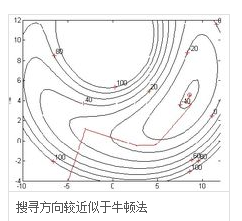
这里写图片描述
上图可知:搜索方法是凹方向,是梯度 or Hession矩阵的相反方向,只有Hession矩阵正定,即每个Hession矩阵每个特征值大于零,才会沿着梯度相反方向,即沿着曲线的凹方向(梯度方向是曲线的凸方向),收敛到局部极值点。

2Hession矩阵需要二次可微。但在计算机视觉下,x比如sift特征,是一个不可微的图像操作,即sift特征是离散的。在这种情况下,我们只能用数值逼近Hession矩阵 or 梯度,但这样做计算成本很大。

3Hession矩阵的维数可能很大。而Hession矩阵的逆矩阵计算的时间复杂度是O(n^3),空间复杂度O(n^2),n是矩阵维数,计算量和空间内存都需要很大,即使用 L-BFGS,计算成本仍然很大。

所以作者提出了a Supervised Descent Method (SDM),来求非线性的最小平方差。
在训练阶段:
通过最小化所有样本的非线性平方差函数之和,
学习许多梯度方向组成的梯度序列
在测试阶段:
SDM minimizes 非线性平方差函数,
使用训练时训练的梯度方向,
再也不用计算 the Jacobian nor the Hessian矩阵 。

(2)Supervised Descent Method(SDM)具体理论原理是什么?
这里研究的SDM是对face alignment application.

这里写图片描述
上公式中:
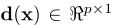
1 d代表一个人脸图片的m个像素,这里写图片描述
2 这里写图片描述
d(x)代表一个图片的66个标点。
3 h是特征抽取函数(比如sift特征抽取),这里写图片描述

h(d(x))是在标点d(x)周围抽取的128维的sift特征。
这里写图片描述
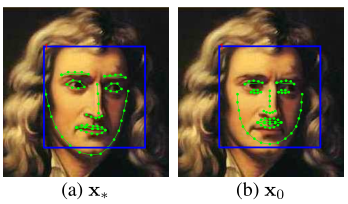
4上图
(a)图在训练期间,假设66个标记是已知,我们称之为X*
(b)图 先用检测到人脸(蓝色矩阵框),再用所有样本平均shape,作为X0,初始化位置。
人脸匹配(face alignment),是极小化公式(3).

Many computer vision problems (e.g., camera calibration, image alignment, structure from motion) are solved through a nonlinear optimization method. It is generally accepted that 2 nd order descent methods are the most robust, fast and reliable approaches for nonlinear optimization of a general smooth function. However, in the context of computer vision, 2 nd order descent methods have two main drawbacks: (1) The function might not be analytically differentiable and numerical approximations are impractical. (2) The Hessian might be large and not positive definite. To address these issues, this paper proposes a Supervised Descent Method (SDM) for minimizing a Non-linear Least Squares (NLS) function. During training, the SDM learns a sequence of descent directions that minimizes the mean of NLS functions sampled at different points. In testing, SDM minimizes the NLS objective using the learned descent directions without computing the Jacobian nor the Hessian. We illustrate the benefits of our approach in synthetic and real examples, and show how SDM achieves state-ofthe-art performance in the problem of facial feature detection. The code is available at www.humansensing.cs. cmu.edu/intraface. 1. Introduction Mathematical optimization has a fundamental impact in solving many problems in computer vision. This fact is apparent by having a quick look into any major conference in computer vision, where a significant number of papers use optimization techniques. Many important problems in computer vision such as structure from motion, image alignment, optical flow, or camera calibration can be posed as solving a nonlinear optimization problem. There are a large number of different approaches to solve these continuous nonlinear optimization problems based on first and second order methods, such as gradient descent [1] for dimensionality reduction, Gauss-Newton for image alignment [22, 5, 14] or Levenberg-Marquardt for structure from motion [8]. “I am hungry. Where is the apple? Gotta do Gradient descent
评论 18
添加红包

请填写红包祝福语或标题

红包个数最小为10个

红包金额最低5元

当前余额3.43前往充值 >
需支付:10.00
成就一亿技术人!
领取后你会自动成为博主和红包主的粉丝 规则
hope_wisdom
发出的红包
实付
使用余额支付
点击重新获取
扫码支付
钱包余额 0

抵扣说明:

1.余额是钱包充值的虚拟货币,按照1:1的比例进行支付金额的抵扣。
2.余额无法直接购买下载,可以购买VIP、付费专栏及课程。

余额充值